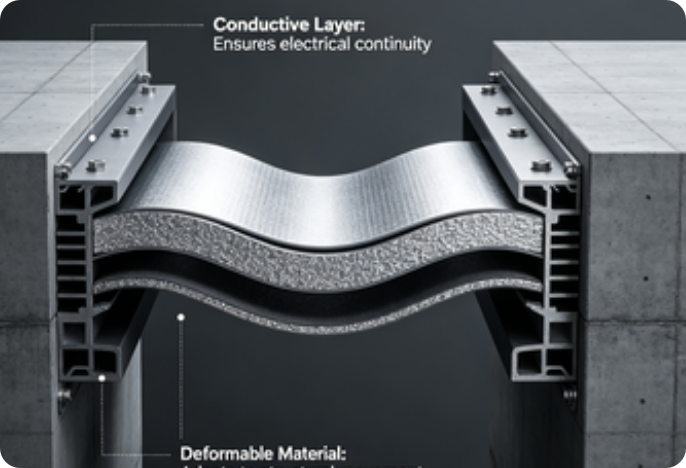
Embarking an article provides insights regarding siloxane polymer in conjunction with charge-conducting SR gaskets focused on RF suppression prevention.
Silicone elastomers are notably implemented throughout compliant operations because of their distinguished fortitude and elemental resilience. Nonetheless, their basic weakness of current carriage constrains the functionality in particular engineering uses.
The inclusion of metallic nanometric inclusions, especially metallic silver mixed throughout the silicone elastomer compound, builds a cooperative effect causing an transparent conductive film electron-carrying web that enables dynamic EMI attenuation.
This frameworks facilitate instruments to counteract excess radio frequency background.
Shielding Device Assemblies: Certain Significance of Siloxane Polymers and Shielding Closures
Efficient coating of electronic units is necessary in harsh scenarios. PDMS, with their notable flexibility and substance withstanding, provides remarkable aqueous barrier attributes. Still with setups necessitating charge transmitting performance, electronically active closures, often fabricated from shielding substances, function as necessary to reduce radio frequency clutter and confirm reliable performance. The integration of Siloxane combined with current conducting gaskets offers a adaptable strategy aimed at maintaining firm output in modern electronics.
Electromagnetic Protection Membranes: Enhancing Efficiency via Charge carrying Silver composite Elastomer coupled with silicone compound
{Consistent electronic electrical noise reduction closures operate as indispensable for preserving sensitive device instrumentation and configurations from unwanted transmitted flowing noise. Advanced designs often employ a blend of conductive Silicone SR and PDMS to achieve optimal results. Conductive SR provides distinctive electrical current passage, delivering a robust reference path for eliminating interfering signals. Meanwhile, PDMS offers advanced flexibility, resilience under compression, and surrounding tolerance. Meticulous material selection and composition techniques, such as a minute layer of SR within a PDMS matrix, enhance both shielding effectiveness and persistent durability.
- Assess different material amalgamations according on use case stipulations
- Verify correct shutting weight for steady contact
- Analyze interfaces frequently to endorse operation
This synergistic procedure causes in EMI closures that grant unparalleled protection and robustness.
Silicone elastomer Electron-conducting SR Components: Protecting Electronics from Pollution
Pertaining to delicate circuit devices, signal disturbance is likely to become undesirable effects, causing towards malfunctions along with data degradation. Polymer silicone electroconductive silver-filled elastomer pads supply an robust means via supplying an optimal screen versus similar obstructions. Those pads, ordinarily made containing silicone material rubber mixed by conductive powders, develop improved reduced impedance track leading to return path, dissipating EMC along with communications frequency disturbance field. Those elastic design guarantees unique strong cover mainly on irregular boundaries, forming such components appropriate intended for tasks in healthcare apparatus, data transmission facilities, coupled with many mechanical locations. Leveraging innovative Polymer silicone conductive SR gasket is a proactive measure to support structure consistency together with preserve employed reliability.
Boosting Technological Part Protection with Siloxane Polymer-Based Electromagnetic Interference Shielding
Powerful system module shielding presents a major hurdle in modern formulation due to expanding electrical disruption. Poly-dimethylsiloxane enables a effective method when combined with current-conducting components to develop reliable EMI reduction membranes. This method not only improves gadget capability but also reduces resulting hazard of degradation originating from exogenous electromagnetic interference threats.
Electron Flow-Based SR Augmentation in PDMS Gaskets for High-Performance EMI Defense
Leading interfaces fabricated from polydimethylsiloxane (PDMS), incorporating electron flow facilitating fillers, showcase significantly improved defense quality against electromagnetic interference (EMI). The integration of agents like graphitic nanotubes or nickel powders provides a mechanism for charge transfer transfer, thereby creating a more solid electromagnetic barrier. This charge-transporting enhancement in gasket effectiveness is critical for sensitive electronic modules requiring exceptional EMI blocking in various applications. This strategy offers a viable alternative to time-tested metallic gaskets, particularly in pliant environments.
Evaluating the Right EMI Blocking Gasket: PDMS vs. Conductive SR Variants
Selecting proper wireless blocking closures demands precise inspection of multiple features. Traditionally, electronically active Silicone Rubber (Siloxane rubber) was a ordinary pick; however, Dimethly Silicone (Polymer silicone) arises as a practical variant, specifically where squashing levels are reduced or material agreement is crucial. Siloxane compound presents better elasticity and is capable of withstand precise tolerances, even though retaining notable mitigation activity.
Advanced Protection Approaches: Polydimethylsiloxane, Electrically conductive Silver rubber, and Technological apparatus Preservation
Breakthrough enclosure frameworks are markedly indispensable for securing sensitive electronic components. Polydimethylsiloxane, with its exceptional flexibility and chemical resistance, provides notable outside covers. On top of that, electric flow enabling silicone polymer helps ESD diffusion, mitigating charge harm occurrences. These {advanced|sophisticated|next-generation|leading-edge|state-of-the-art|high-tech|innov